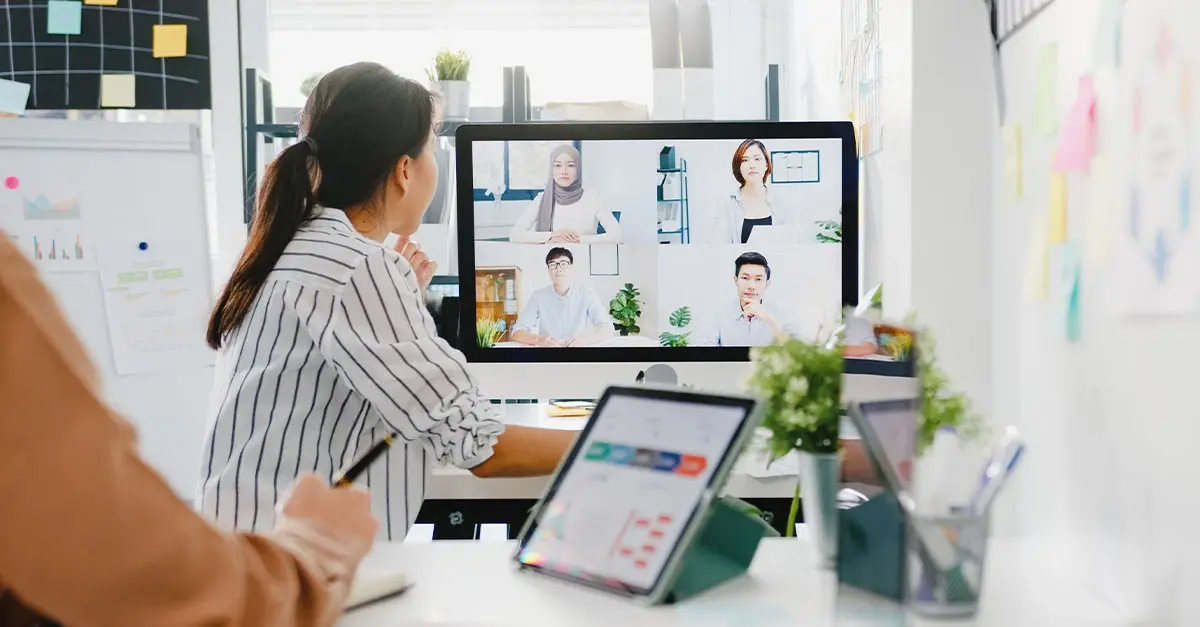
Among remote capable jobs in the U.S, more than half of all employees now work in a hybrid arrangement, while just 22% work entirely on-site. It’s clear that a hybrid work model is not a trend; it's a permanent shift. What began as a pandemic-era necessity has become the default model for many modern organizations.
That shift is reshaping how companies think about office space utilization, workplace technology, hybrid team management and employee retention strategies. For facility and workplace managers, this creates an opportunity to provide flexibility, boost productivity and enhance work-life balance.
This guide covers everything you need to know, including definitions, the four main types of hybrid work models, proven benefits and software that makes it all work.
What is a Hybrid Work Model?
A hybrid work model is a flexible work arrangement that combines remote and in-office work. Unlike traditional setups where employees are present in the office full-time, a hybrid work model allows employees to split time between on-site and remote locations. It is also known as a blended work model or flexible hybrid schedule.
This approach can improve work-life balance and employee experience. In fact, 72% of remote and hybrid workers say flexible work leads to better work-life balance and when employees have more control over where they work, many report feeling more productive.
4 Key Characteristics of a Hybrid Work Model
There are four key features that distinguish the hybrid work model from conventional work structures.
Variability in Location
One of the most significant characteristics of the hybrid work model is location flexibility. Employees can alternate between working in the office or remotely depending on their needs and the company's policy. This is distinct from fully remote work, where employees never come on-site, or traditional office work, where they always do.
Flexible Scheduling
The hybrid work model provides employees with more control over how they structure their workday. That could look like shifting their hours slightly, choosing their most productive environment, or adjusting their schedule around team needs. Rather than a rigid, one-size-fits-all schedule, hybrid policies can accommodate different working styles helping employees stay focused and engaged, while meeting their professional commitments.
Technology-Driven Experiences
Hybrid work success depends on the right technology to keep operations running smoothly. Beyond communication tools like Microsoft Teams or Slack, organizations rely on workplace management software to handle the operational side, such as optimizing office space, managing room and desk bookings and ensuring the physical workspace supports a workforce that is not always on-site at the same time.
Outcome-Based Performance
The flexible work model shifts how companies evaluate performance from presence-based measurement to a focus on results and accountability. This is sometimes referred to as a results-only work environment (ROWE). Employees are expected to meet their objectives and deliver on their responsibilities, regardless of where they are working.

Types of Hybrid Work Models
Choosing the right hybrid structure depends on team size, role types and culture. Here are the four most common models.
Remote-First Model
In the remote-first model, employees work remotely by default, with office visits occurring for specific purposes. Teams primarily use the physical office for meetings, collaboration or special projects rather than daily work. This model suits companies with distributed global teams or those prioritizing talent access over geography.
Office-Occasional Model
The office-occasional model schedules specific days when employees work on-site. For example, working from home on Monday and Fridays, while working from the office Tuesday through Thursday. This is one of the most common hybrid work schedule examples, aligning well with most corporate workflows.
Week-by-Week Model
Teams alternate between remote and in-office work on a weekly or bi-weekly basis. This model is especially effective for project-based teams who need focused sprints in both settings. This structured rotation helps organizations plan workspace utilization more effectively while giving employees a varied and predictable work routine.
At-Will Model
The at-will model offers the most flexibility. Employees choose when to work remotely and when to come in, with minimal expectations from the organization. This model works best for work cultures built on trust and accountability, where employees take ownership of their work regardless of location.
Benefits of a Hybrid Work Model
The business case for hybrid work is well established. Here are the most significant advantages for both employees and employers.
Increased Productivity
Workers often report higher productivity levels when they have more control over their work environment. Stanford economist Nicholas Bloom's research found that hybrid workers are just as productive and likely to be promoted as their office-based peers. More notably, resignations dropped 33% among workers who shifted from full-time in the office to a hybrid work schedule.
Cost Savings
Organizations can reduce real estate and operational costs by optimizing office space for a workforce that is not on-site every day. According to Global Workplace Analytics, employers save an average of $11,000 per year for every employee who works remotely half the time. Employees can also benefit financially by saving on commuting and other expenses associated with daily office work — making the hybrid model an economically practical option for both employers and employees.
Improved Talent Acquisition and Retention
Hybrid work and employee retention are closely linked. A 2023 McKinsey study found that employees who lack schedule flexibility are more than twice as likely to seek a new job. Offering hybrid options expands the talent pool beyond geographic constraints and reduces costly turnover.
Improved Work-Life Balance
A flexible work model allows employees to better manage their professional responsibilities while reducing stress and burnout. The flexibility to work from home can also save significant commute time. The average U.S. worker spends 27 minutes commuting each way, and if the person is using public transportation, it's notably longer.
Essential Software for a Hybrid Work Model
Technology is the backbone of any successful hybrid strategy. The right hybrid work technology stack includes two layers: communication tools and space management software.
Communication and Collaboration Tools
Effective hybrid work relies on software that supports team interaction. Tools like Zoom, Slack and Microsoft Teams enable instant messaging, video conferencing, file sharing and collaborative workplaces. Prioritize platforms with strong mobile apps, async-friendly features and integration with your workplace management platform.
Space Management and Scheduling Software
When teams split time between locations, organizations need tools to manage the physical workspace effectively. Space management software and desk booking software help coordinate office resources, minimize scheduling conflicts and ensure the workspace is used efficiently. Tools, like Accruent EMS, offer advanced capabilities for managing workspace reservations, monitoring space utilization and streamlining meeting schedules.
Workplace Analytics and Reporting
Workplace analytics tools provide facilities managers with data-driven insights into how office space is actually being used. Which areas are over-utilized, which areas are under-utilized and when peak usage occurs. This data directly informs real estate decisions and space planning.
How Accruent EMS Supports Hybrid Work
Accruent EMS optimizes hybrid work environments by managing resource scheduling, space booking and team communication across both remote and on-site environments. Accruent EMS is built to support the changing needs of modern workplaces, where flexibility and efficient resource management are paramount.
Key capabilities include:
- Resource Scheduling: Book and manage shared workspaces, including hot desks, conference rooms and flex spaces to maximize office space use when occupancy fluctuates.
- Space Utilization Analytics: Identify occupancy patterns and make data-backed decisions about office layouts and lease renewals.
- Integrated Communication: Facilitate smooth communication between remote and on-site teams.
- Mobile Access: Enable employees to manage schedules and book resources with a mobile app.
- System Integrations: Connect with Outlook, Google Calendar, HR platforms, and building management systems for a unified workflow.
With Accruent EMS, companies address the logistical challenges of hybrid work models while reaping the many benefits. It helps to foster a culture of employee satisfaction that drives productivity and results.
Hybrid Work Across Industries
Hybrid work isn't limited to tech companies. It's reshaping operations across sectors each with their own unique challenges.
Hybrid work in Technology
Technology companies were early adopters. According to Forrester, 30% of economic labor in the U.S. is performed from home. Companies like Google, Apple and Salesforce have piloted different hybrid structures offering useful case studies for organizations designing their own policies.
Hybrid work in Financial Services
Financial institutions and professional services firms have embraced hybrid models while preserving face-to-face interaction. JPMorgan Chase implemented a structured three-day-in-office policy, while Goldman Sachs has adopted a more traditional approach. This illustrates that even within one industry, hybrid strategies differ significantly.
Hybrid work in Higher Education
Higher Education institutions are accustomed to hybrid working models. Students may attend classes on-site one day and remotely on others. Professors often lecture in person and handle preparation and grading remotely.
When students and faculty rely on shared resources, having a resource management system that provides easy and accurate visibility of available space is not just a luxury; it's critical.
For example, Accruent EMS streamlined campus operations at Duke University. Before implementing Accruent’s software campus wide, the institution didn’t have standardization of room or building names across their various tools. This lack of uniformity caused challenges with scheduling and reporting that Accruent EMS solved.
Case Study: Data Integration Company Improves Office Efficiency with Accruent EMS
Imagine, you’re a global data integration company with 21 offices and 1500 employees. Ensuring employees have access to the right resources, at the right time, can be a time-consuming task. The company needed to reduce administrative time spent on room and desk booking, streamline reservation workflows and eliminate ghost meetings.
Once Accruent EMS was introduced, the office management team went from spending 30% of the work week managing requests to 5-10%.
Accruent: Your Hybrid Work Model Partner
Embracing a hybrid work model can boost productivity, support employee well-being and reduce operational costs. Accruent EMS makes the transition seamless by optimizing work place management and enhancing collaboration, helping organizations design a space that works for everyone, wherever they are.
.svg)