Total productive maintenance (TPM) is a proactive maintenance strategy that gives machine operators a daily role in caring for the equipment they run, with the aim of maximizing overall equipment effectiveness. TPM engages all levels and functions of an organization, from the plant floor to senior leadership, rather than leaving equipment health to the maintenance department alone. Manufacturers and other asset-intensive operations use TPM to work toward zero breakdowns, zero defects and zero accidents.
Consider a manufacturing plant where the same filling line stops three times a week. Each stop lasts only a few minutes, so nobody logs it, but the line gives up hours of production every month and the maintenance team spends its days chasing failures instead of preventing them. Output targets slip, quality complaints climb and the overall equipment effectiveness score tells a story nobody wants to present at the monthly review.
Total productive maintenance offers a different way to run that plant. This article explains the principles behind it, walks through the eight pillars and shows how a computerized maintenance management system (CMMS) helps you put the strategy into daily practice.
What is total productive maintenance?
Total productive maintenance is a maintenance philosophy that treats equipment reliability as a responsibility shared across production and maintenance rather than the job of one department. It was developed in Japanese manufacturing and is credited to Seiichi Nakajima, who worked with the Japan Institute of Plant Maintenance (JIPM) to formalize the approach in the decades after World War II.
The United States Environmental Protection Agency (EPA) describes TPM as a method that engages every level and function of an organization in order to maximize the overall effectiveness of production equipment. TPM addresses the full production system lifecycle and builds a plant-floor-based system for preventing accidents, defects and breakdowns.
Practitioners usually summarize the ambition of a TPM program as three zeros: zero breakdowns, zero defects and zero accidents. The EPA states the ultimate goals as zero equipment breakdowns and zero product defects, which improve how well an organization uses its production assets and plant capacity.
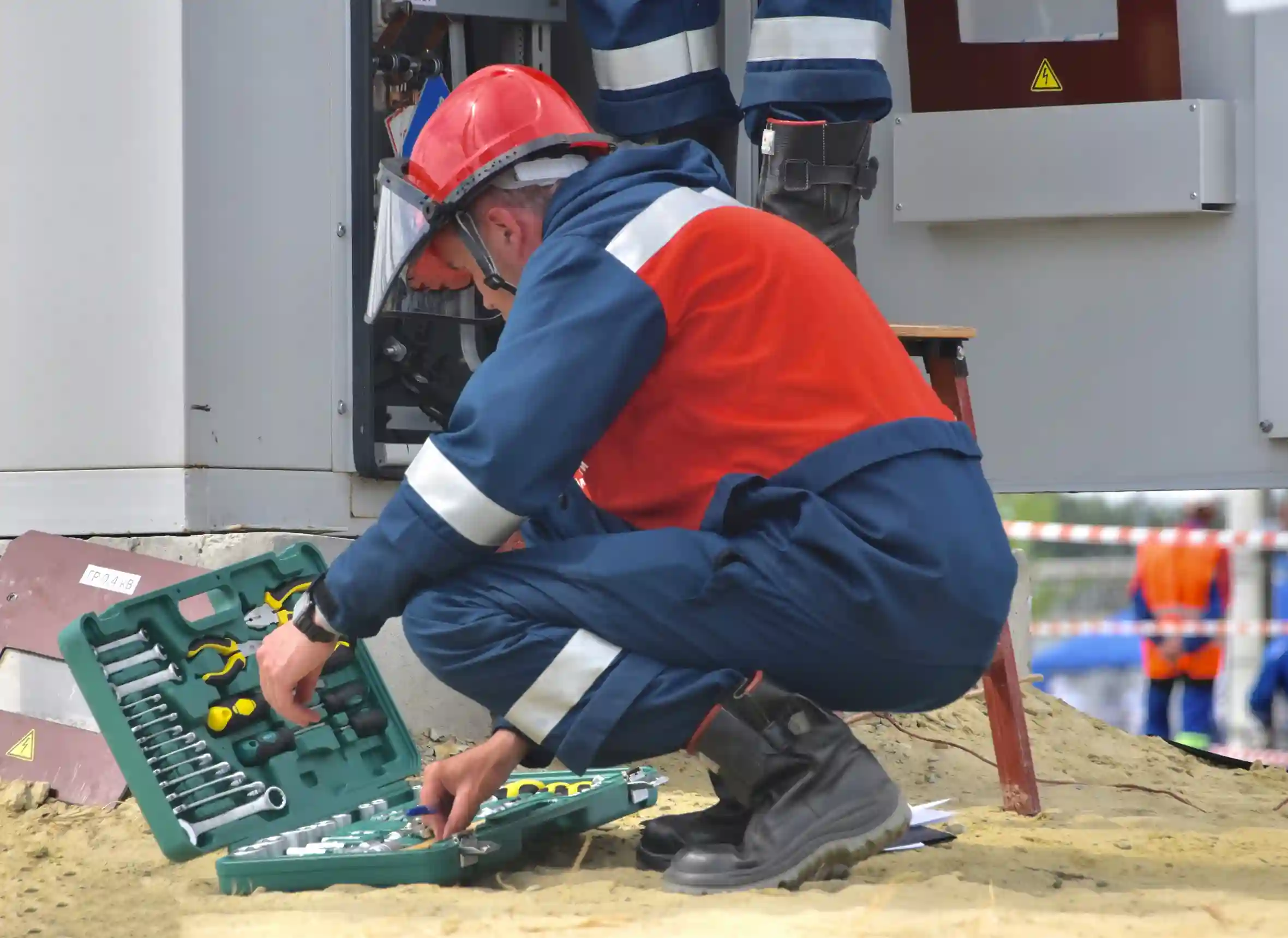
The idea that makes TPM distinct is ownership. Operators run the machines every day, so they notice a new vibration, a small leak or a change in sound long before a scheduled inspection would catch it. TPM gives them a defined role in daily equipment care, which frees technicians for skilled diagnostic and repair work. If you are weighing this strategy against the alternatives, our overview of maintenance management strategies puts TPM in context.
The core principles of TPM maintenance
Four principles separate a TPM program from a purely reactive approach:
1. Operator ownership
Operators clean, inspect and lubricate the machines they run and report abnormalities early, which surfaces small problems while they are still small.
2. Shared responsibility
Production and maintenance work from the same equipment data and the same targets, so reliability stops being one department's problem.
3. Continuous improvement
Small teams identify the specific losses that hold a machine back, remove them and then standardize the fix so it holds.
4. Prevention over repair
The program invests effort upstream, in condition monitoring, mistake-proofing and better equipment specification, so fewer failures ever reach the floor.
The 5S foundation of TPM
Most TPM programs rest on 5S, a workplace organization method named for five steps:
- Sort
- Set in order
- Shine
- Standardize
- Sustain
“Sort” removes whatever the area does not need. “Set in order” gives every tool and part a fixed home. “Shine” keeps the equipment and the space clean, which doubles as inspection, because a clean machine shows a leak or a loose fitting immediately. “Standardize” turns the first three steps into a documented routine, and “Sustain” keeps that routine alive through audits and habits.
5S matters because the eight pillars need a stable base. Autonomous maintenance is a difficult thing to ask of an operator who cannot find a grease gun, and abnormalities hide easily in clutter. A clean, organized and standardized workplace is what makes the pillars sustainable.
The 8 pillars of total productive maintenance
The framework in widest use comes from the Japan Institute of Plant Maintenance (JIPM). Sources order and name the pillars slightly differently, so treat the list below as the commonly used version rather than a single fixed standard.
1. Autonomous maintenance
Operators take on routine cleaning, inspection and lubrication for the machines they run. Problems surface earlier, and technicians gain time for skilled work such as root cause analysis and overhauls. The EPA identifies autonomous maintenance as a key aspect of TPM and describes its daily activities as precision checks, lubrication, parts replacement, simple repairs and abnormality detection.
2. Planned maintenance
Teams schedule maintenance work around equipment condition and failure history rather than convenience, so tasks happen before a breakdown instead of after one. This is where preventive maintenance schedules, spare parts planning and agreed downtime windows come together. Handled well, planned maintenance converts unpredictable stops into shorter, predictable ones.
3. Quality maintenance
Teams trace defects back to the equipment conditions that cause them, then design detection and prevention into the process. Mistake-proofing devices, known as poka-yoke, either make an error impossible or signal it the moment it happens. The target is zero defects rather than more inspection after the fact.
4. Focused improvement
Small cross-functional teams work continuously to eliminate the specific losses that hold a machine or a line back. These teams usually pair an operator, a technician and an engineer so the fix reflects how the equipment actually runs. Each improvement is then standardized so it does not quietly reverse.
5. Early equipment management
Lessons from existing machines feed into the design, purchase and installation of new ones. Maintenance and operations contribute requirements early, covering service access, standard components and realistic start-up plans. New equipment then reaches full output sooner and costs less to maintain across its life.
6. Education and training
Operators, technicians and managers each build the skills their own role requires. Operators learn to inspect and detect abnormalities, technicians develop diagnostic depth and managers learn to read the data and support the program. Training is easy to defer and expensive to skip, because every other pillar depends on people who can carry it out.
7. Safety, health and environment
This pillar removes hazards and unsafe conditions before they cause an incident, which supports the goal of zero accidents. The EPA describes TPM safety activity as addressing dangerous conditions before they lead to accidents, damage and unanticipated costs, using tools such as safety checklists and standardized operating procedures. Equipment can also be modified to reduce spills, leaks and upset conditions.
8. Office and administrative TPM
The same loss-elimination thinking applies to the administrative work that supports the shop floor, including scheduling, procurement, inventory records and information flow. A purchase order that arrives late for a bearing stops a line just as effectively as a bearing that fails. Office TPM looks for the delays, rework and handoffs that create those stoppages.
Total productive maintenance and overall equipment effectiveness: how success is measured
Overall equipment effectiveness (OEE) is the headline metric for a TPM program. You calculate it by multiplying three percentages together: availability, performance and quality. Availability covers how much of the scheduled time the equipment actually ran, performance compares real output against the rate the machine should sustain and quality measures how much of that output met specification the first time.
OEE is useful because it maps directly onto what TPM sets out to remove. The EPA identifies six major losses: unexpected breakdowns, setup and adjustment, stoppages, speed losses, quality defects and equipment and capital investment losses. Each one lands in one of the three OEE components, which is why a single score can point you toward the pillar that needs attention. The EPA also reports that most companies can achieve a 15 to 25 percent increase in equipment efficiency rates within three years of adopting TPM.
How to implement TPM: a step-by-step approach
A practical TPM rollout tends to follow six steps:
- Secure leadership support. Operators need protected time for daily care, granted rather than borrowed from production targets.
- Choose one pilot area. Pick a single line or a single critical machine where downtime is visible and the team is willing.
- Restore the equipment to a clean baseline. Apply 5S, deep clean the asset and clear the deferred faults, so later measurements start from a known state.
- Launch autonomous and planned maintenance together. Give operators a short daily route and put the technician tasks on a real schedule.
- Measure OEE from day one. Without a baseline, the gain cannot be demonstrated, and the pilot needs a result to justify expansion.
- Expand what works. Carry the standards, checklists and schedules that proved out to the next area rather than starting over.
How a CMMS supports your TPM maintenance program
TPM asks a lot of people to do a lot of small things consistently, across shifts, across lines and often across several sites. That is precisely the kind of work that degrades when it lives on paper or in a spreadsheet. A CMMS gives the program a system of record.
Mapped against the pillars of total productive maintenance, a CMMS does the following:
- Autonomous maintenance: Digital checklists put the correct inspection route in an operator's hands, and every completed check builds an asset history the whole team can see.
- Planned maintenance: Automated schedules and meter-based or condition-based triggers raise work orders on time, so the routine happens without anyone having to remember it. The harder part is deciding what belongs on those schedules in the first place, which is the work of building a preventive maintenance program rather than configuring the software.
- Quality maintenance: Failure codes and defect tracking against specific assets reveal which machines cause which defects.
- Focused improvement: Downtime and loss data give improvement teams evidence rather than opinion so they can decide what to tackle first.
- Early equipment management: Complete cost and repair histories show which models are worth specifying again and which are not.
- Education and training: Training and certification records held against each technician make it clear who is qualified for which task.
- Safety, health and environment: Standard procedures, permits and audit trails attach to the work order itself.
A combined CMMS and enterprise asset management (EAM) platform supports all eight pillars of TPM in one system. Accruent Maintenance Connection, used by industry leaders in more than 75 countries, is one such platform. Work order automation and preventive maintenance scheduling carry the routines behind autonomous and planned maintenance, while asset tracking and inventory management build the cost and repair histories that early equipment management depends on. Reporting then turns recorded downtime into the loss data focused improvement teams use to choose their next target.
When choosing a CMMS software for manufacturing, the right one depends on your plant, your existing integrations and your budget. A multi-site operation usually weighs standardization across sites most heavily, while a single plant cares more about whether operators will keep up the daily routes that autonomous maintenance depends on.
Build a stronger total productive maintenance program with Accruent
TPM is a people-first strategy before it is a software strategy. It works when operators take genuine ownership of the equipment they run, when production and maintenance share the same goals and when leadership funds the training and the pilot time. What a CMMS adds is repeatability: the schedules run, the checks get recorded, the losses get counted and the results hold up across shifts and sites.
If you would like to see how CMMS software could support the pillars in your plant, request a demo and we will walk you through it.
.svg)



.jpg)