Your retail estate is more than a collection of physical stores. Every site you have represents its own sales channel, brand experience, service hub, and operational asset. This makes retail estate management increasingly complex, especially if you operate across markets such as the U.S., UK and Europe. In the U.S. alone, large retail tenants can have tens of thousands of locations. On a global scale, Walmart operates more than 10,800 stores across 19 countries, Aldi has more than 13,800 and 7-Eleven has more than 41,000 global locations.
The challenge lies in the fact that so many retail estates are still managed through fragmented systems. Your real estate teams, facilities leaders, construction teams, maintenance providers and operations teams may have access to information they each need, but that data often lives in different, unconnected places. If the full lifecycle of a store is fragmented, it’s harder for you to see risk, control costs, plan investments and maintain consistent performance.
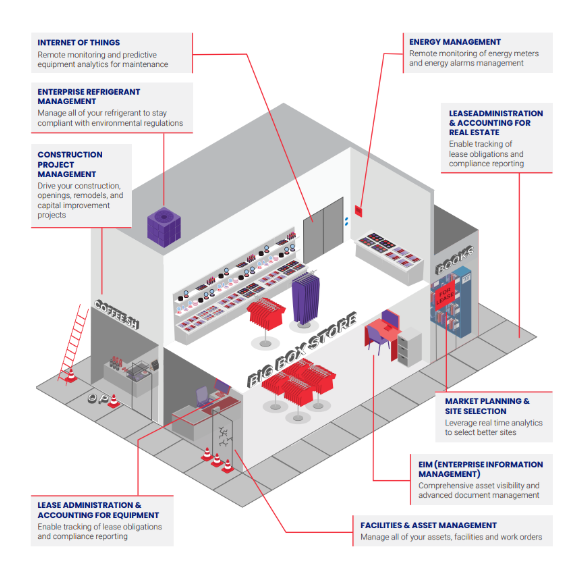
To build a more resilient retail estate, you need a connected ecosystem that links real estate, capital projects, operational visibility and maintenance management. This helps you to enable better decision-making across the full store lifecycle, fueling stronger performance.
This article examines the challenges created by fragmented systems and disconnected data. Learn how improved visibility acts as a foundation for the intelligent store and how the shift toward a more connected retail estate model that supports proactive, data-driven decision-making.
Related Read: Retail Real Estate Reinvented: 4 Trends Shaping What’s Next
Retail Estate Management Has Become a Lifecycle Challenge
Once you’ve decided to open a store, its performance is heavily shaped by decisions made before the first customers come through the door. The efficiency of that location’s operations over time is dependent on things like site selection, lease terms, design choices, construction timelines and asset planning. If any of those early decisions are disconnected from facilities and maintenance realities or customer needs, when you open the store, you risk inheriting costs that could have been avoided.
Retail estate management needs to be treated like an entire lifecycle vs. a series of separate handoffs from phase to phase. Think of it this way: lease agreements affect operating flexibility; capital projects affect future maintenance needs; asset choices can affect things like energy consumption and compliance maintenance. The bottom line is that every stage creates new data that you should be using to inform the next.
When you leverage technology to approach the store lifecycle as a fully connected process, you can gain a much clearer view of how individual decisions influence performance in a long-term capacity. CBRE even notes that connecting facilities management, real estate and project management data can help you derive more value from technology investments. Having your planning, investment and operations all working together ultimately shapes the actual value of the estate.
Fragmented systems create blind spots across the store lifecycle
Without a shared view of performance, it’s difficult to make decisions and act, even if your teams are aligned around the same goals. Gaps form between decision points, creating critical blind spots. For example, a site with recurring equipment failures might not be prioritized during capital planning. A refurbishment may start moving ahead without a full view of maintenance history.
Over time, blind spots make estate performance harder to manage because by the time you realize where the blind spots are, too many challenges have arisen as a result. You may find yourself spending more time reconciling information than actually being able to take action on it. Decisions become reactive, occurring once issues have already affected operations.
Disconnected data makes performance tougher to manage
You may have accessible data around maintenance activity, project spend, lease obligations, asset conditions, energy usage and store performance, but that’s only one part of the equation. Inconsistent data points are difficult to analyze together, meaning you don’t get a reliable view of your full estate health. When you’re trying to understand which locations are performing (or not) and what assets are creating recurring costs, fragmented data gets in the way, making it nearly impossible to uncover where investment can have the most impact.
The issue goes beyond having access to more data. Chances are you already have that access. Whether you can trust, compare and act on it across markets is the true challenge. This kind of data environment isolates performance snapshots leading to decisions being made without a clear understanding of cost and risk impacts.
The Intelligent Store Depends on Lifecycle Visibility
Managing your store estate with more confidence requires in depth visibility and understanding of how each location is performing across its full lifecycle. This visibility provides you with a clearer connection between decisions made about a site and the outcomes that follow as a result. That context is what allows you to conduct more informed estate planning.
A more connected approach helps close any gaps by giving your teams a shared view of a location, its assets and its role in the wider portfolio. That shared view creates an operational picture that everyone can access and make decisions from, so it’s easier to prioritize investment, reduce avoidable disruption and manage your larger estate strategy.
Case Study: Festival Foods Asset Monitoring and Maintenance
Connected estate operations improve cost control and resilience
Connected estate operations is about having the right context to understand better ways of managing costs. You can see how each instance, from maintenance spend to asset issues to project delays, affects the entire estate portfolio. As a result, you can get ahead of cost build up and risk.
Visibility into every aspect of your retail estate is what supports short and long-term resilience. It’s what allows your teams to connect operational signals, no matter where those signals originate from. This lets you reduce disruptions, protect store uptime and support long-term performance rather than short-term fixes.
What a connected retail estate model looks like
It’s important to understand that you don’t have to get every market, region or store format to operate in exactly the same way. What you want is a more practical way to manage performance across your estate’s full lifecycle.
A shared foundation, or a connected retail estate model like Accruent Data Connect for Lucernex, lets everyone make decisions with greater consistency and confidence. Data Connect delivers a curated, governed data layer that can easily and seamlessly plug into Power BI, Tableau and enterprise data platforms. This kind of connected technology solution helps you achieve trusted reporting, forecasting and AI-driven insights.
Here’s what you need to accomplish a connected model:
|
Action
|
What it helps you do
|
|
Connect portfolio planning to operational reality
|
Make informed property and investment decisions based on a clear understanding of store conditions, asset needs and operating costs.
|
|
Bring capital projects and facilities teams into the same lifecycle view
|
Plan openings, remodels and refurbishments with more awareness into maintenance history, site constraints and operational requirements.
|
|
Standardize your asset and maintenance data
|
Compare performance across locations more reliably and find where recurring issues are driving avoidable costs or disruptions.
|
|
Use operational intelligence to prioritize action
|
Focus your resources on sites, assets and projects that have the greatest impact on cost, risk and performance.
|
|
Build regional flexibility into an enterprise view and global model
|
Give your local teams room to manage market-specific requirements while providing consistent views for leadership of the whole portfolio.
|
With a connected retail estate model in place, your estate management becomes much more coordinated. For instance, project teams can understand downstream impacts from their work. Your facilities and maintenance crews can actually use asset-level insight to support broader priorities. Each location is managed as part of your connected system. It will still account for regional/market differences while also giving you a stronger way to manage your investment and get out ahead of operational needs.
Download: Accruent Data Connect for Lucernex: Enable Powerful Real Estate Data Analytics
Start Your Integration Journey to Meet the Future of Retail Estate Management
Expectations and pressures for retail stores continue to rise. Your estate performance will depend largely on how effectively you can connect the work behind the scenes to make customer engagement and experience as seamless as possible.
Physical retail has a role to play, and in order to fulfill that it needs operating models that help you spot risk sooner and direct investments with purpose. The intelligent store is only possible through coordinated decision making and action across property, projects, facilities and maintenance. This is what will give you and your teams true clarity and operational control.
To find out how leading retailers are using data-driven maintenance strategies to improve uptime, compliance and asset performance, explore The 2026 Retail Maintenance Playbook.
.svg)