A computerized maintenance management system (CMMS) is software for maintaining physical assets and for covering work orders, preventive maintenance schedules and asset records. An enterprise resource planning (ERP) system is software that unifies business functions such as finance, procurement and human resources. In a CMMS vs ERP comparison, the difference comes down to purpose: a CMMS manages how assets are maintained, while an ERP system manages how the business runs. The two often work together.
Picture a maintenance manager at a utility company. The finance team already runs an ERP system, and a leader asks whether it can handle maintenance, too. The answer depends on the assets involved, the regulations behind them and the data that has to move between teams. This article compares CMMS vs. ERP systems, explains when each one fits and shows how they connect. It also looks at how a CMMS such as Accruent Maintenance Connection works alongside the ERP system you already run.
- ✓ CMMS software manages asset maintenance, from work orders and preventive maintenance to MRO inventory and audit records.
- ✓ ERP systems unify business functions such as finance, procurement, human resources and supply chain.
- ✓ Organizations with critical assets often run both systems and connect them so parts requests and maintenance costs reach the ERP system without re-entry.
What is a CMMS?
A CMMS is software focused on maintenance operations. A CMMS covers:
- Work order management
- Preventive maintenance scheduling
- Asset maintenance records
- Maintenance, repair and operations (MRO) inventory
- Reporting and audit preparedness
Technicians, planners and managers use a CMMS every day. Technicians open and close work orders, planners build preventive maintenance schedules and managers review asset history and backlog. For a deeper definition, read our guide on what a CMMS is.
What is an ERP system?
An ERP system is software that unifies core business functions across departments. An ERP system covers:
- Finance
- Human resources
- Procurement
- Supply chain
Finance, procurement, human resources and operations teams use an ERP system every day. Finance team members approve purchase orders, procurement teams manage suppliers and orders and managers review budgets across departments. Its strength is the shared record. A purchase order, an invoice and a general ledger entry live in the same place, so every department works from the same numbers.
Some ERP systems also include a maintenance module that can record equipment, log work and connect it to purchasing. That suits organizations where maintenance is a small part of operations.
CMMS vs ERP: Key differences
The core difference between an ERP vs CMMS is what each system is built around. A CMMS is built around physical assets and their upkeep, while an ERP system is built around business transactions across departments. That is why CMMS vs ERP is less of a contest but rather a question of which job needs doing.
| Area |
CMMS |
ERP |
| Primary purpose |
Manages asset maintenance, from work orders to asset records |
Unifies business processes such as finance, procurement and human resources |
| Typical users |
Technicians, planners, maintenance managers and reliability engineers |
Finance, procurement, human resources and operations teams |
| Maintenance depth |
Built around preventive maintenance, repair history and MRO inventory |
Varies by system, and some include a maintenance module |
| Financial depth |
Tracks maintenance labor and parts costs |
Manages budgets, purchasing and the general ledger |
Neither system is better in every case. An ERP system is strongest where departments need one shared record of transactions, and a CMMS is strongest where assets need dedicated upkeep.
ERP vs CMMS: Users and daily workflows
Consider a typical day in each system. In a CMMS, a technician at a utility company receives a work order, checks the repair history for the asset, records the labor and parts used and closes the job. In an ERP system, a finance team member reviews a purchase order, checks it against the budget and approves it. Both workflows matter, but they touch different records and call for different levels of detail.
Data and reporting
The two systems hold different data, so they answer different questions. A CMMS holds asset history, repair records, preventive maintenance activity and parts usage. Maintenance teams use that data to ask which assets cause the most downtime and which scheduled work is overdue. An ERP system holds budgets, purchasing and financial records, so finance teams use it to ask what the company spent and where.
Accruent lists downtime by asset, preventive maintenance compliance and overdue work orders among the reports a CMMS can produce. See how Accruent Maintenance Connection handles reporting and analytics.
When to use a CMMS, an ERP system or both
The CMMS vs ERP choice depends on how many critical assets an operation runs and how closely it is regulated. The three scenarios below offer a starting point.
When a CMMS is the better fit
A CMMS fits operations with many critical assets and active preventive maintenance programs. Teams in utilities, oil and gas and manufacturing often maintain equipment across distributed sites, where an unexpected failure can disrupt operations. Mining operations often depend on heavy equipment that must keep running, so planners need maintenance schedules and records tied to each asset.
Regulated settings such as pharmaceutical manufacturing and healthcare add another need: audit readiness. Accruent Maintenance Connection helps simplify FDA and ISO regulatory compliance with electronic signatures, simple audit trails and streamlined procedure versioning for pharmaceutical organizations.
When an ERP maintenance module may be enough
An ERP maintenance module may be enough when maintenance is a small part of operations and the asset base is limited. If a team manages a handful of pieces of equipment, runs simple schedules and already works in the ERP system every day, one system keeps records in one place. Even then, review the module against your preventive maintenance and reporting needs before you decide.
A maintenance module and a dedicated CMMS are not interchangeable labels, and the depth of a module varies by ERP system. Test any option against your own workflows, such as scheduling preventive maintenance, closing work orders from the field and preparing for an audit.
When to use both
Larger organizations often run finance and procurement in an ERP system and maintenance in a CMMS. Connecting the two keeps each system focused on its own job and avoids re-entering the same data by hand.
Signs that ERP-only maintenance tracking is no longer enough include:
- Preventive maintenance schedules kept in spreadsheets
- Repair history that is hard to find by asset
- MRO inventory records that do not match what is on the shelf
- Audit preparation that takes heavy manual effort
If any of these sound familiar, book a demo to see how a CMMS handles them.
How a CMMS and an ERP system work together
Integration keeps maintenance and financial records in sync. The CMMS holds the maintenance detail, and the ERP system holds the financial and purchasing records. When the two connect, a parts request or a cost recorded in one system reaches the other without re-entry, which is one of the benefits of integrating a CMMS with an ERP system. The example below shows how that data moves between the two systems.
Here is how one repair might move between the two systems:
- A maintenance request becomes a work order in the CMMS.
- A technician completes the work and records labor and parts.
- If a part is out of stock, a parts request reaches ERP purchasing.
- Labor and parts costs reach the financial records in the ERP system.
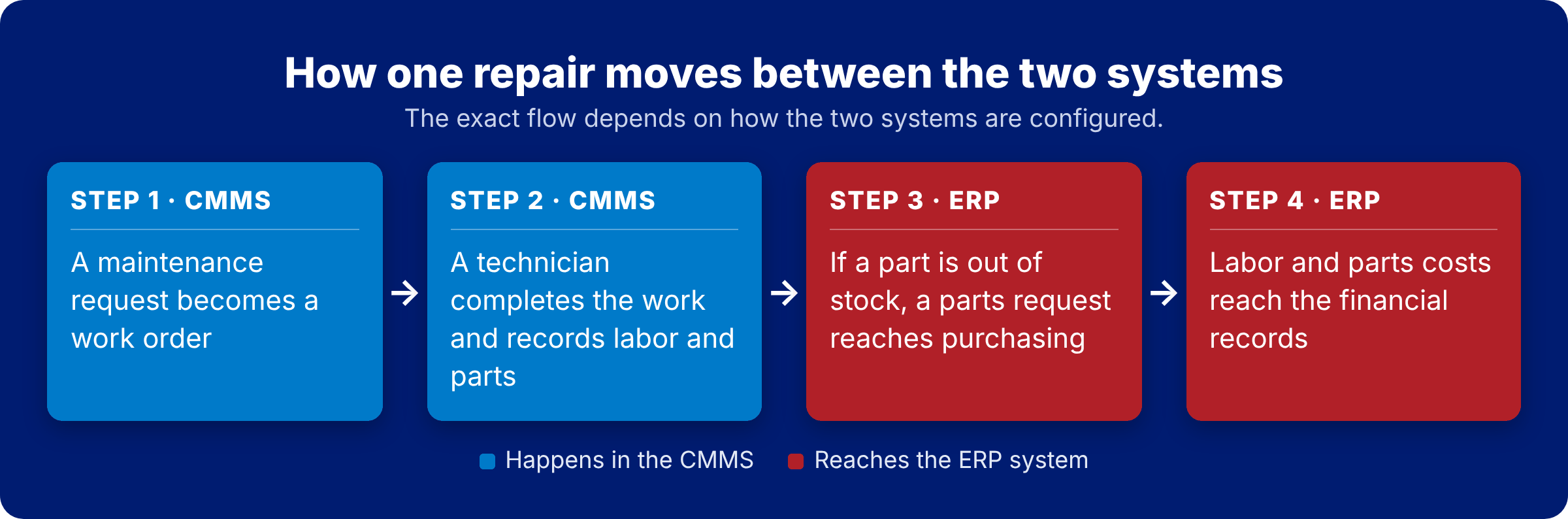
The exact flow depends on how the two systems are configured.
Accruent Maintenance Connection connects to ERP systems in two ways. A pre-built integration hub covers accounting systems, ERPs and fleet management tools. An application programming interface (API) known as the Web API lets teams query and update data such as work orders and parts in real time. Guided setup also lets teams import, export and schedule integrations without information technology (IT) consultants.
Choose the right system mix with Accruent
A CMMS and an ERP system do different jobs, and the strongest setup connects them together. Whether to use a CMMS vs ERP comes down to the work each system needs to do. If your assets are critical, your maintenance programs are active or your audits are demanding, a dedicated CMMS deserves a place beside your ERP system.
Before you decide, discuss three topics with your maintenance, finance and IT teams:
- The number of critical assets the operation maintains
- The level of regulatory scrutiny on maintenance records
- The data that must move between maintenance and finance
Accruent Maintenance Connection is a CMMS built for asset-intensive industries, with integrations that connect it to the ERP system you already run.
Accruent Maintenance Connection
See how a CMMS works alongside your ERP system
Book a demo to see work orders, preventive maintenance and ERP integration in action.
Book a demo